Few astronomical events capture the public imagination quite like the passage of a bright comet. These magnificent “dirty snowballs”—mixtures of ice, dust, and rock—are ancient relics from the solar system’s formation, traveling vast distances from its coldest, outermost reaches. When they approach the sun, their frozen material vaporizes, creating the breathtaking tail that can stretch for millions of miles, turning them into spectacular celestial visitors. The sight of a comet streaking across the night sky evokes a primal sense of wonder, but their importance extends far beyond aesthetics. The passage of comets through our part of the solar system is a critical event for scientific discovery and a constant reminder of the dynamic, sometimes volatile, nature of our cosmic neighborhood.
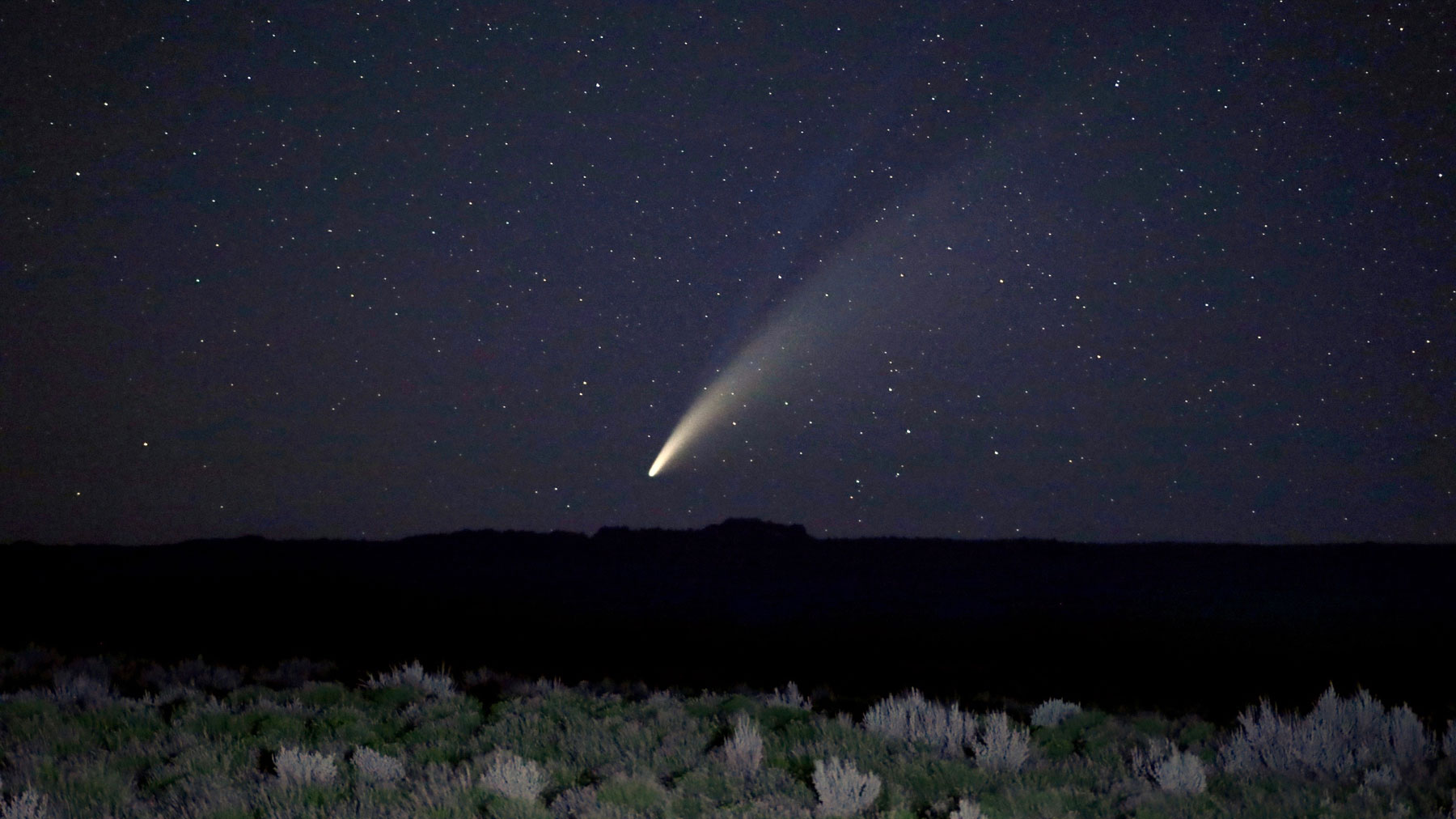
This article explores the science behind these icy travelers, the impact they have on our world, and why the study of passing comets is essential to understanding the origins of life on Earth.
The Anatomy of a Celestial Snowball
To understand the drama of a passing comet, one must first grasp its basic composition and behavior. Comets originate primarily from two regions: the Kuiper Belt (a donut-shaped region beyond Neptune) and the far more distant, spherical Oort Cloud.
- The Nucleus (The Core): This is the heart of the comet, a relatively small, solid body typically a few kilometers wide, composed of water ice, frozen gases (like methane and ammonia), and embedded dust and rocky material. It is essentially a frozen snapshot of the early solar system.
- The Coma (The Head): As the comet approaches the sun, solar radiation heats the nucleus, causing the ice to sublimate (turn directly into gas), forming a massive, temporary atmosphere around the nucleus called the coma, which can expand hundreds of thousands of kilometers.
- The Tail (The Signature): Solar wind and radiation pressure push the coma’s material away, forming the famous tail. Often, a comet displays two distinct tails: a straight, blue ion (gas) tail pushed directly away by the solar wind, and a curved, white dust tail pushed away by radiation pressure, tracing the comet’s curved orbital path.
The spectacular display only occurs when a comet is close enough to the sun (usually within the orbit of Mars) for this sublimation process to begin.
Comets as Scientific Time Capsules
For scientists, particularly astrobiologists and planetary scientists, a passing comet is not just a light show; it is a precious sample of primordial material that holds secrets about the solar system’s genesis.
- Probing Planetary Formation: Comets have remained largely unaltered since the solar system formed some 4.6 billion years ago. By studying the chemical and isotopic composition of the nucleus and coma, scientists can gain crucial insights into the conditions, temperature, and material mix of the protoplanetary disk that gave birth to the Earth and other planets.
- The Origin of Earth’s Water: One of the most significant theories posits that early Earth was dry, and much of the water that makes up our oceans was delivered by the constant bombardment of water-rich comets and asteroids billions of years ago. Analyzing the ratio of deuterium to hydrogen (heavy water) in cometary ice helps test this hypothesis and reveals the source of Earth’s most vital resource.
- Delivering the Seeds of Life: Perhaps the most profound discovery is the presence of complex organic molecules—the building blocks of life, such as amino acids—within cometary material. This supports the theory of Panspermia, suggesting that cometary impacts may have seeded the early Earth with the chemical ingredients necessary for life to emerge.
The Risk and the Spectacle: Impact and Discovery
The study of passing comets also keeps us acutely aware of the risk of impact, alongside the thrill of potential discovery.
- Near-Earth Objects (NEOs): While the vast majority of comets follow stable, distant orbits, the gravitational influence of the planets, particularly Jupiter, can occasionally send a comet hurtling onto a path that crosses Earth’s orbit. Agencies like NASA maintain extensive catalogs to track these Near-Earth Objects (NEOs) to ensure we have early warning of any potential impact threat.
- The Spectacle of Great Comets: Occasionally, a comet with a large nucleus and a close solar approach becomes a “Great Comet,” visible even during the day or becoming so brilliant it dominates the night sky. These rare events, like Comet Hale-Bopp in the 1990s, serve as a potent reminder of the majesty of the cosmos and inspire generations of future scientists.
- Space Missions to Comets: The only way to truly unlock a comet’s secrets is to visit one. Missions like the European Space Agency’s Rosetta probe, which successfully landed a Philae lander on Comet 67P/Churyumov-Gerasimenko, have provided unprecedented, high-definition data on their internal structure and chemical complexity, forever changing our understanding of these celestial snowballs.
Conclusion
The passage of a comet through our solar system is a moment of deep significance. It is a stunning natural spectacle, a moving piece of primordial ice, and a scientific treasure trove that offers tangible clues about the very origins of our water and the chemical ingredients for life. By tracking, studying, and even visiting these celestial visitors, humanity continues to piece together the history of our solar system and remains vigilant against the potential, albeit rare, threat of cosmic impact. The comet is, therefore, not just a beautiful flash in the sky, but a critical link between the frozen, distant past and the vibrant, living present of our home planet.
Would you like me to elaborate on the specific space missions that have been launched to study comets up close?